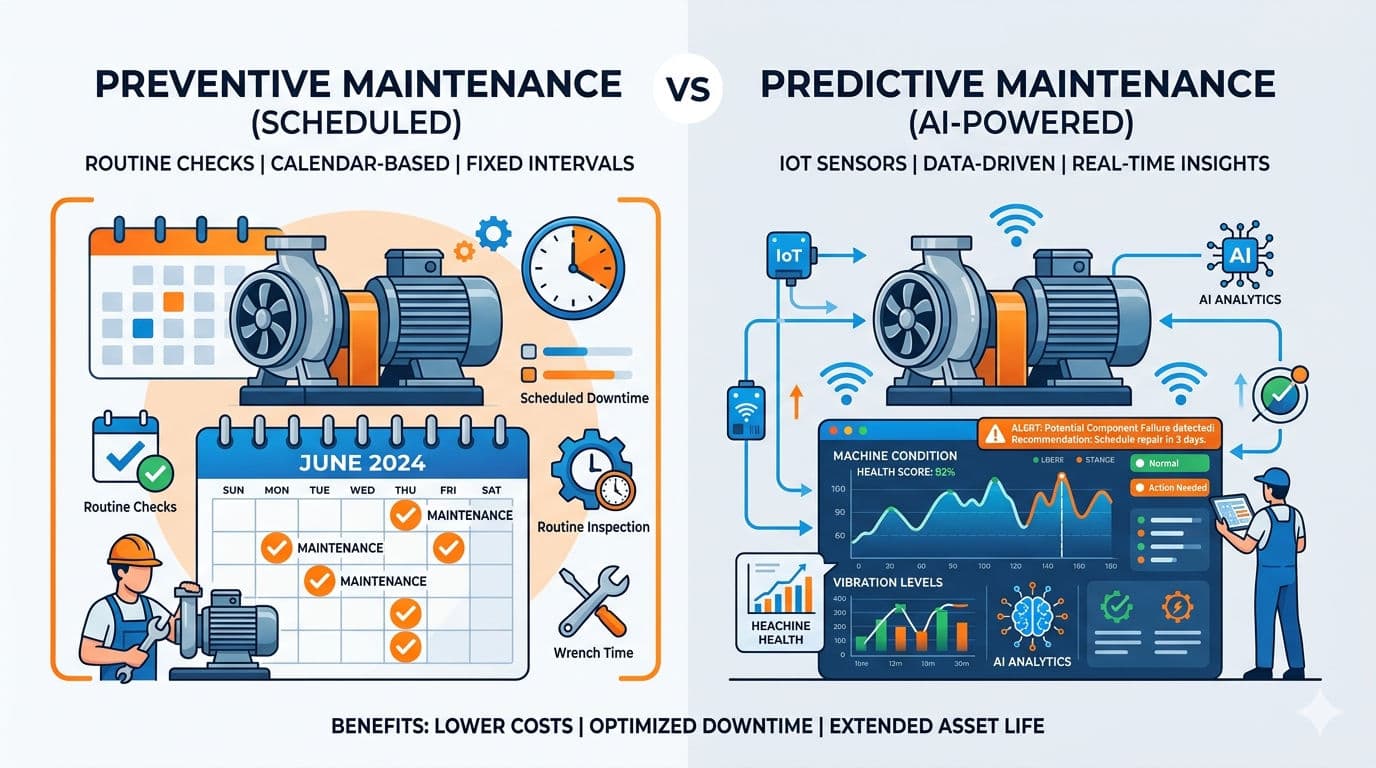

Understand the difference between preventive and predictive maintenance, how IoT and AI improve efficiency, and which strategy is best for your operations.
Preventive and predictive maintenance are two of the most widely used strategies in modern maintenance management. While both aim to reduce downtime and extend asset lifespan, they operate in fundamentally different ways.
Understanding the difference is critical for any organization looking to optimize operations, reduce costs, and move toward smarter maintenance practices.
What Is Preventive Maintenance?
Preventive maintenance is a time-based approach where maintenance tasks are performed at regular intervals, regardless of the actual condition of the equipment.
This could include:
Scheduled inspections
Routine servicing
Planned part replacements
For example, a machine might be serviced every 3 months or after a fixed number of operating hours.
The goal is simple: prevent failures before they happen by maintaining equipment regularly.
What Is Predictive Maintenance?
Predictive maintenance is a data-driven approach that uses real-time data to determine when maintenance should be performed.
Instead of following a fixed schedule, it relies on:
Sensor data
Machine learning (AI)
Asset performance analysis
For example, a system may detect increasing vibration levels in a motor and predict that failure is likely within a few days. Maintenance is then scheduled only when needed.

What Is the Main Difference Between Preventive and Predictive Maintenance?
The key difference lies in how decisions are made:
Preventive maintenance = based on time or usage
Predictive maintenance = based on real-time data and asset condition
Preventive maintenance is proactive, but predictive maintenance is intelligent and adaptive.
When Should You Use Preventive Maintenance?
Preventive maintenance is ideal when:
Equipment is simple and predictable
Failure patterns are well known
IoT infrastructure is not available
Budget is limited
It is easy to implement and does not require advanced technology.
However, it can lead to:
Unnecessary maintenance
Higher operational costs
Missed early warning signs
When Should You Use Predictive Maintenance?
Predictive maintenance is best when:
Equipment is critical to operations
Downtime is costly
Real-time monitoring is possible
Data can be collected and analyzed
It allows organizations to:
Reduce downtime
Optimize maintenance schedules
Extend asset lifespan
How IoT Enables Predictive Maintenance
Predictive maintenance is not possible without data—and that’s where IoT comes in.
IoT sensors continuously monitor asset conditions such as:
Temperature
Vibration
Pressure
Usage cycles
This data is sent in real time to a CMMS, where it is analyzed.
If you want to understand this deeper, read:
👉 IoT-Enabled CMMS & Real-Time Data
How AI Enhances Predictive Maintenance
AI takes IoT data and turns it into actionable insights.
Instead of just monitoring data, AI:
Detects anomalies
Identifies patterns
Predicts failures
This is explained in more detail here:
👉 AI-Powered Predictive Maintenance in CMMS
Together, IoT + AI create a system that not only monitors assets—but understands them.
Preventive vs Predictive Maintenance: Side-by-Side Comparison
Factor | Preventive Maintenance | Predictive Maintenance |
|---|---|---|
Approach | Time-based | Data-driven |
Cost | Moderate | Optimized long-term |
Downtime | Reduced | Minimized |
Technology | Low | High (IoT + AI) |
Efficiency | Medium | High |
Which One Is Better?
There is no one-size-fits-all answer.
For most modern organizations, the best approach is a hybrid model:
Use preventive maintenance for simple assets
Use predictive maintenance for critical equipment
This ensures cost efficiency while maximizing performance.
Real-World Example
A facility maintains HVAC systems.
Using preventive maintenance:
Filters are replaced every 3 months
Systems are inspected regularly
Using predictive maintenance:
Sensors monitor airflow and temperature
AI detects inefficiencies early
Maintenance is triggered only when needed
Result:
Lower costs
Less downtime
Better performance

The Future of Maintenance
Maintenance is evolving rapidly.
We are moving toward:
Fully automated systems
AI-driven decisions
Real-time optimization
CMMS platforms like Servora are designed to support this evolution by combining:
Cloud-native architecture
IoT integrations
AI-powered insights
Mobile-first usability
Final Thoughts
Preventive maintenance helped organizations move from reactive to proactive.
Predictive maintenance takes it a step further—making maintenance intelligent, efficient, and data-driven.
If your goal is to reduce downtime, optimize costs, and scale operations, predictive maintenance is the future.