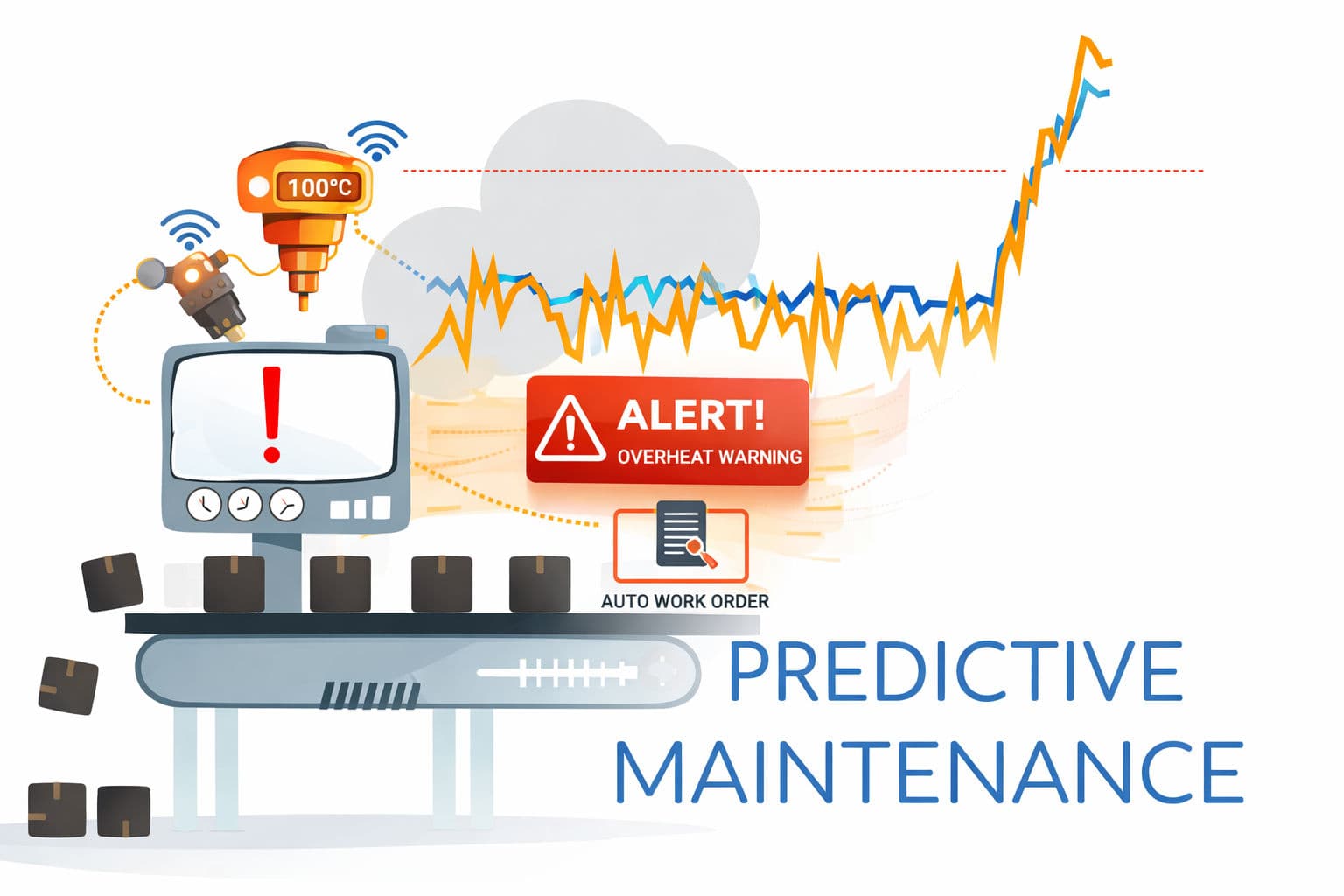

Learn how AI-powered predictive maintenance in CMMS uses IoT data to prevent failures, reduce downtime, and optimize asset performance in real time.
AI-powered predictive maintenance is rapidly becoming the standard for modern maintenance operations. Instead of reacting to failures or relying on fixed schedules, organizations can now anticipate issues before they happen. This shift is driven by two core technologies: artificial intelligence (AI) and the Internet of Things (IoT).
Together, they transform a CMMS from a simple work order system into an intelligent decision-making engine.
What Is AI-Powered Predictive Maintenance?
AI-powered predictive maintenance uses machine learning algorithms to analyze data from equipment and predict when a failure is likely to occur.
Unlike preventive maintenance, which is based on time intervals, predictive maintenance is based on actual asset condition.
In simple terms:
Preventive maintenance = fixed schedule
Predictive maintenance = data-driven timing
This allows organizations to perform maintenance only when necessary—reducing both downtime and unnecessary work.
How Does Predictive Maintenance Work in a CMMS?
Predictive maintenance inside a CMMS follows a structured process:
First, data is collected from assets through IoT sensors. These sensors monitor conditions such as temperature, vibration, pressure, and usage patterns.
Second, this data is analyzed using AI models. These models identify patterns, anomalies, and early signs of failure.
Third, the CMMS takes action. It can automatically generate work orders, send alerts, or adjust maintenance schedules.
This creates a fully automated, intelligent maintenance loop.
Where Does IoT Fit Into Predictive Maintenance?
IoT is the foundation of predictive maintenance.
Without IoT, AI would not have real-time data to analyze.
IoT devices continuously stream live data into the CMMS, enabling:
Real-time monitoring
Early anomaly detection
Continuous performance tracking
If you want a deeper understanding of how IoT works in CMMS, read this guide:
IoT-Enabled CMMS & Real-Time Data
This connection between IoT and AI is what enables predictive maintenance to function effectively.
Why Is AI + IoT a Game Changer for CMMS?
The combination of AI and IoT creates a system that is:
1. Proactive Instead of Reactive
Issues are detected before they cause failure.
2. Data-Driven Instead of Assumption-Based
Decisions are based on real asset conditions.
3. Automated Instead of Manual
Workflows trigger automatically without human input.
This dramatically improves efficiency across maintenance operations.
Key Benefits of AI-Powered Predictive Maintenance
One of the biggest advantages is reduced downtime. By identifying problems early, organizations can avoid unexpected breakdowns.
Another major benefit is cost optimization. Maintenance is performed only when needed, reducing unnecessary labor and spare parts usage.
Asset lifespan is also extended. Equipment is maintained at optimal times, preventing both overuse and neglect.
Additionally, predictive maintenance improves planning. Maintenance teams can schedule work more efficiently and allocate resources more effectively.
Real-World Example
Imagine a production machine equipped with vibration sensors.
The system detects a slight increase in vibration levels—something that might not be noticeable during routine inspections.
AI analyzes the data and identifies a pattern consistent with bearing wear.
Instead of waiting for failure, the CMMS automatically generates a work order.
The issue is resolved before it leads to downtime.
This is predictive maintenance in action.
Challenges to Consider
Despite its advantages, implementing predictive maintenance requires:
IoT sensor infrastructure
Data integration capabilities
AI-ready systems
Without the right platform, organizations may struggle with complexity or data overload.
This is why modern CMMS platforms are critical.
How Servora Supports Predictive Maintenance
Servora is designed to support the evolution toward intelligent maintenance.
With its cloud-native architecture, it enables seamless integration with IoT systems and supports real-time data processing.
Its focus on usability ensures that advanced capabilities like predictive maintenance remain accessible—not complex.
Combined with mobile-first and offline-first functionality, Servora ensures maintenance teams can act on insights anytime, anywhere.
The Future of Maintenance: Autonomous Systems
Predictive maintenance is only the beginning.
The future includes:
AI-driven automation
Self-optimizing systems
Autonomous maintenance workflows
As AI models become more advanced, CMMS platforms will evolve into fully intelligent operational systems.
Final Thoughts
AI-powered predictive maintenance represents a fundamental shift in how maintenance is managed.
By combining IoT data with AI intelligence, organizations can:
Prevent failures
Reduce costs
Improve efficiency
This is not just an upgrade—it is the next generation of maintenance.